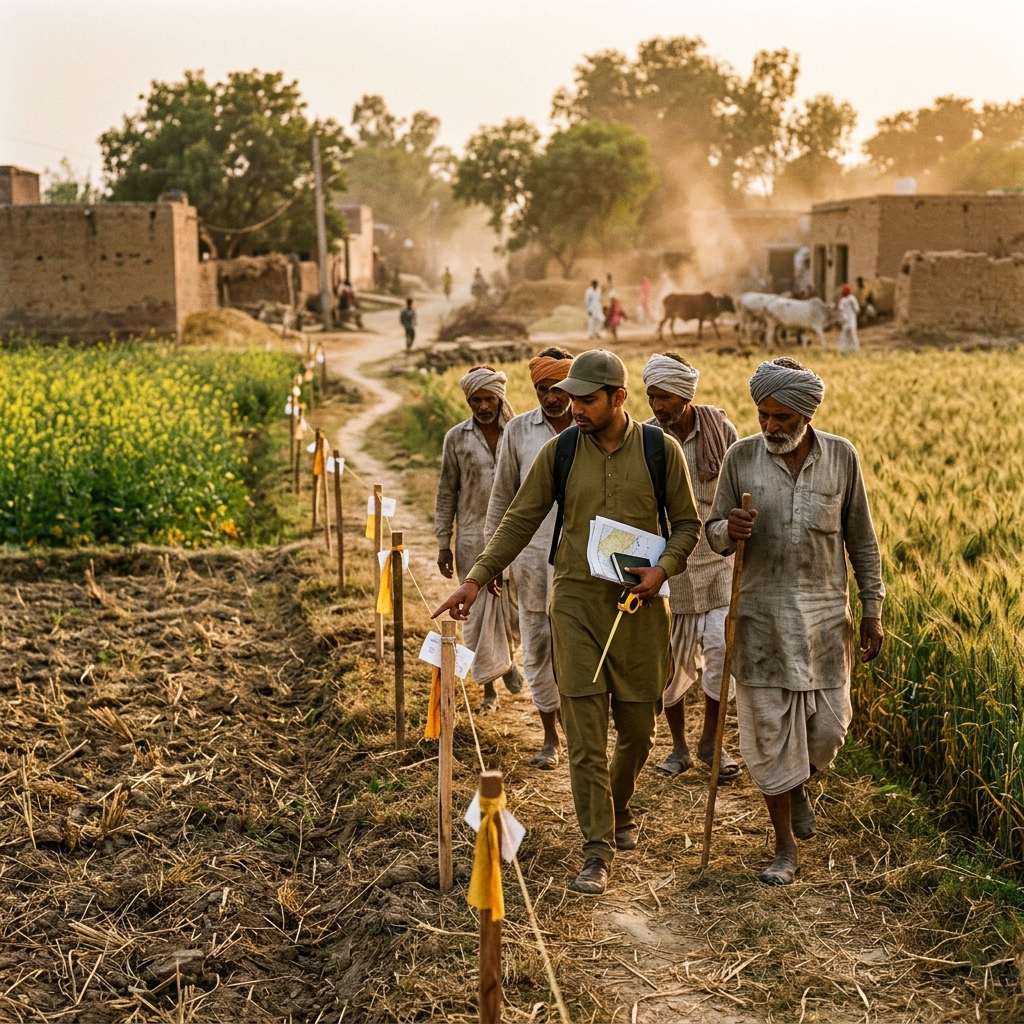
How we find land before the market does.
Most participants price land on what it is today. We price it on what it is permitted to become.
The problem was never the land. It was the record.
Land records in India are fragmented across offices such as the tehsil, mutation records and layout approvals, and no single source tells the whole story. A parcel can look clean in one register and carry a boundary dispute in another. That gap, between what a record says and what the ground shows, is exactly why Bhaarat Wealth Group exists.
So we built a method around it, not a hunch. We call it demand-supply intelligence: a repeatable way of combining what the ground tells us with what the records prove, so a decision rests on evidence rather than guesswork.
Two sources of truth, read as one.
Most people rely on one or the other. We insist on both. When on-ground reality and the official record agree, an outcome becomes far more predictable than a guess ever could be.
On-ground field data
Direct farmer and landowner conversations, physical boundary checks, and a registry-office network that reads a micro-market before it shows up in any database.
Registry & government data
Sale-deed registrations, CLU notifications, sanctioned tenders and infrastructure approvals, pulled from public records and read together as one picture.
We verify from the ground up, in that order.
Village Level
Direct conversations with landowners, brokers and village contacts. This is the first, unfiltered read on what a parcel really is.
Tehsil Records
Official records are pulled to verify ownership, survey details and legal history against what the ground tells us.
Local Network
Our registry-office and stakeholder network validates the parcel before anyone else in the market has seen it.
Standardising land into signal.
Raw ground data is inconsistent by nature. Different villages and registrars record the same facts differently. We convert that noise into signal by applying one fixed assessment framework to every parcel, regardless of where or how it was sourced.
The real profit sits at the farmer level.
Land closest to the source is the least standardised: mismatched names across deeds, memory-drawn boundaries, and title passing through inheritance before the paperwork catches up. That is exactly where we work.
1
assessment framework applied to every parcel, whatever its source
Farmer-level
one of the largest direct relationship networks in this space
Source-first
we buy where land is least standardised, and least contested on price
Six points to clear before any parcel reaches an investor.
Tender Study
Every notified government tender and infrastructure project within radius is mapped.
Demand-Supply Intelligence
Checked against comparable registered transactions in the micro-market.
Registry Velocity
Transaction pace measured against the corridor average to read real momentum.
On-ground Liaisoning
Farmer-level title and boundary walked in person before a parcel qualifies.
CLU Status
Verified against the latest government notification, never assumed from precedent.
FAR Entitlement
Floor Area Ratio verified against current policy, not a prior cycle's numbers.
Your two biggest fears, taken off the table.
Unclear paperwork and illegal occupation, or kabza, are what keep people out of land. Both are handled inside the same six-point clearance every parcel already passes, before it is ever offered to you.
Title & documentation
Ownership, encumbrance history and survey details are cross-checked across tehsil and mutation records, then independently validated by Uttar Pradesh-specialist legal partners before a rupee moves. This is the CLU Status and records work in our six-point clearance, applied to every parcel.
Kabza & encroachment
Possession is physically walked and confirmed on the ground, boundaries verified against the record, and any occupation or dispute surfaced through our liaisoning network. This is the On-ground Liaisoning step of the clearance. A parcel with unclear possession never reaches an investor.
FAR and CLU aren't indicators. They're multipliers.
What is Floor Area Ratio (FAR)?
Floor Area Ratio is the ratio of a building's total constructible floor area to the size of the plot it sits on. In Indian real estate, FAR is set by the local master plan and directly caps how much can be built, so a higher FAR entitlement can multiply the developable value of the same piece of land. We verify FAR against current policy for every parcel, because entitlements change between planning cycles.
What is Change of Land Use (CLU)?
Change of Land Use is the legal conversion of a parcel's permitted use, for example from agricultural to commercial or residential. CLU is what turns cheap agricultural land into developable, re-ratable land. We verify CLU status against the latest notification and never assume it from a neighbouring parcel's precedent.
A FAR or CLU re-rating rarely waits for a road to open. Government infrastructure runs on published timelines, so tenders, sanctions and completion dates give a parcel a window: the closer a corridor moves to becoming inevitable, the sooner permitted use and price begin to re-rate. Reading those timelines is how we tell which parcels re-rate ahead of completion, and when that window is likely to open.
How we picked one parcel, and the process we followed.
Gata-1184 in Ayodhya is the clearest illustration of the method end to end. Every step below is the same clearance and intelligence work described on this page, applied to a single, real parcel.
Realized result
Gata-1184, exited. A confirmed historical result, not a forward projection.
Identified early
The parcel surfaced through infrastructure and registry signals before the wider market repriced it.
Cleared and validated
Legal path, land use and registry-backed demand were confirmed through the six-point process.
Positioned
Structured and positioned for its highest-conviction exit.
Exited
Realized a 3.4x return. A confirmed historical result, not a forward projection.
How we take your capital and grow it.
A simple, transparent path from first conversation to exit. You hold the land in your own name at every step.
A conversation, not a pitch
We understand what you want from land and answer every question. No pooled fund, no pressure.
We source and diligence a parcel
A specific parcel is identified and cleared through our full verification process, then presented to you as a Site Intelligence Brief.
You take registered title
You acquire the parcel in your own name. The land is yours, held directly, never through a pooled vehicle.
We manage through to exit
We position the asset and handle the exit. We do not charge on the way in. Our compensation is earned at exit, tied to your profit.
"In a market built on asymmetry, timing is the return."
We do not charge on the way in. Our compensation is earned at exit, tied to investor profit. If a transaction does not perform, neither do we.